
Legal English terms: common terms by topic and their Turkish equivalents
From contracts to criminal procedure and from company law to intellectual property, this guide groups the legal English terms you are likely to meet by topic, with a short Turkish equivalent for each.
Knowing a legal term means more than knowing its Turkish translation: you also need to know which legal system it belongs to, whether Turkish law has a true equivalent and how the term behaves in a sentence. The list below is grouped by topic, and each group opens with the distinctions that matter most. For an overview, see legal English for Turkish lawyers. Each term links to its page in our legal term directory, with a definition and an example sentence; those pages are in Turkish.
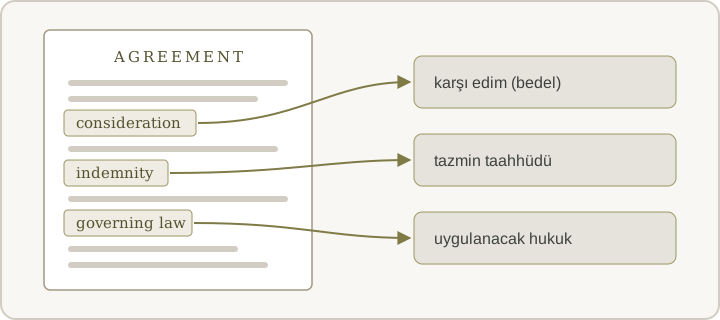
Three principles for learning terms
- Learn each term with the words it travels with. Phrases such as breach of contract, liable for and governed by are easier to remember than single words.
- Keep British and American usage apart. The same concept may have a different name in each system, so check which system a document belongs to.
- Explain what has no equivalent. For a concept with no Turkish counterpart, a short explanation is usually more accurate than a one-word translation.
To study terms inside real contract and litigation texts, with video lessons taught in Turkish, take a look at the Legal English Training Set.
Contract terms
Many of the first terms you meet in an English contract are the names of standard clauses. Representation and warranty are often confused: the first is a statement that leads a party to enter the contract, the second a promise given in the contract itself, and the remedies differ. An indemnity is a promise to cover a specific loss; liquidated damages are agreed in advance, and nothing that depends on a condition precedent takes effect until it is met.
- consideration
- karşı edim (bedel)
- representation
- beyan
- warranty
- garanti (güvence) beyanı
- covenant
- taahhüt
- indemnity
- tazmin taahhüdü
- breach of contract
- sözleşmeye aykırılık
- liquidated damages
- götürü tazminat
- condition precedent
- geciktirici şart (ön koşul)
- termination
- fesih; sona erme
- force majeure
- mücbir sebep
- assignment
- devir (alacağın temliki)
- novation
- sözleşmenin devri; yenileme (tecdit)
- waiver
- feragat (haktan vazgeçme)
- severability
- bölünebilirlik (kısmi geçersizlik)
- governing law
- uygulanacak hukuk
- counterparty
- karşı taraf
Litigation and procedure
Litigation is where British and American usage differ most. The party bringing a civil claim is a claimant in England and Wales and a plaintiff in the United States, and English courts use a witness summons where American courts issue a subpoena. American texts speak of the statute of limitations; English texts speak of the limitation period, the time within which a claim must be brought.
- claimant
- davacı
- plaintiff
- davacı (ABD)
- defendant
- davalı; ceza yargılamasında sanık
- litigation
- dava süreci (yargılama)
- jurisdiction
- yargı yetkisi
- burden of proof
- ispat yükü
- res judicata
- kesin hüküm
- statute of limitations
- zamanaşımı
- appeal
- kanun yolu başvurusu (istinaf, temyiz)
- injunction
- ihtiyati tedbir; yapma ya da yapmama emri
- affidavit
- yeminli yazılı beyan
- subpoena
- celpname (zorunlu çağrı)
Arbitration, mediation and settlement
The dispute resolution clause of an international contract often chooses arbitration, where arbitrators give a binding decision. In mediation a mediator helps the parties reach their own settlement and decides nothing. An arbitral award can be enforced abroad under the New York Convention, to which Türkiye is a party.
- arbitration
- tahkim
- arbitral award
- hakem kararı
- mediation
- arabuluculuk
- settlement
- sulh (uzlaşma)
Liability and compensation
Watch the number: damage is harm, while damages means compensation. Strict liability needs no fault, vicarious liability makes one person answer for another's act, as an employer does for an employee, and under joint and several liability a creditor may claim the whole debt from any one debtor.
- tort
- haksız fiil
- negligence
- ihmal (özen yükümlülüğünün ihlali)
- liability
- sorumluluk
- damages
- tazminat
- strict liability
- kusursuz sorumluluk
- vicarious liability
- başkasının fiilinden sorumluluk
- joint and several liability
- müteselsil sorumluluk
- set-off
- takas
- unjust enrichment
- sebepsiz zenginleşme
Company law
These terms cover setting up, running and buying companies. The board of directors manages the company; in the United States its internal rules are set out in its bylaws. A subsidiary is controlled by another company, and due diligence is the legal review carried out before an acquisition.
- shareholder
- pay sahibi (hissedar)
- board of directors
- yönetim kurulu
- bylaws
- şirket iç yönetmeliği (ABD)
- dividend
- kâr payı (temettü)
- subsidiary
- bağlı şirket (yavru şirket)
- joint venture
- ortak girişim
- merger
- birleşme
- acquisition
- devralma (satın alma)
- due diligence
- hukuki inceleme (durum tespiti)
- fiduciary
- güven ilişkisine dayalı; sadakat yükümlüsü
Property, security and insolvency
A mortgage is security over land, and collateral is any asset that secures a debt. In English law a lien is usually a right to keep goods until payment, close to the Turkish right of retention; in the United States it is a broader security interest. In England bankruptcy applies only to individuals, while companies fall under insolvency.
- mortgage
- ipotek
- lease
- kira sözleşmesi; kiralama
- easement
- irtifak hakkı
- collateral
- teminat
- lien
- hapis hakkı
- guarantor
- kefil (garantör)
- escrow
- emanet (escrow) düzenlemesi
- insolvency
- ödeme aczi
- bankruptcy
- iflas
International law and trade
A treaty is an agreement between states, and sovereign immunity protects a state from being sued in another state's courts. Public documents for use abroad carry an apostille where both countries are party to the Apostille Convention, and a letter of credit is the bank undertaking that secures payment in many export deals.
- treaty
- antlaşma (uluslararası sözleşme)
- sovereign immunity
- devlet bağışıklığı
- extradition
- suçluların iadesi
- apostille
- apostil şerhi
- letter of credit
- akreditif
Criminal law
In criminal proceedings the defendant is the accused. The physical element of an offence is the actus reus and the mental element the mens rea. An indictment sets out the charges, and a trial ends in conviction or acquittal. The American plea bargain has no exact Turkish counterpart.
- actus reus
- suçun maddi unsuru
- mens rea
- suçun manevi unsuru
- indictment
- iddianame
- bail
- kefaletle salıverme
- plea bargain
- itiraf pazarlığı (ABD)
- presumption of innocence
- masumiyet karinesi
- conviction
- mahkûmiyet
- acquittal
- beraat
Employment law
The notice period is the time a party must give before ending the contract. In English law, unfair dismissal is dismissal without a fair reason or without a fair procedure, constructive dismissal is resigning because of the employer's serious breach, and redundancy is dismissal because the job is no longer needed. Severance pay is often translated as kıdem tazminatı, but the two do not share the same conditions.
- employment contract
- iş sözleşmesi
- notice period
- bildirim (ihbar) süresi
- unfair dismissal
- geçerli nedene dayanmayan fesih (geçersiz fesih)
- constructive dismissal
- dolaylı fesih
- redundancy
- işletme gerekçesiyle işten çıkarma
- severance pay
- kıdem tazminatı (işten ayrılma tazminatı)
- non-compete clause
- rekabet yasağı kaydı
- collective bargaining
- toplu pazarlık
Intellectual property
Intellectual property covers copyright, trade marks, patents and trade secrets. Using a protected work, mark or invention without permission is infringement; the permission is a licence and the payment for it a royalty. In American English license is both noun and verb; British English spells the noun licence.
- intellectual property
- fikri mülkiyet
- copyright
- telif hakkı
- trade mark (US: trademark)
- marka
- patent
- patent
- trade secret
- ticari sır
- infringement
- hak ihlali (tecavüz)
- licence (US: license)
- lisans
- royalty
- lisans ücreti (telif ücreti)
Latin expressions
Latin phrases are still common and are often printed in italics. Mutatis mutandis means that a provision applies to another case with the necessary changes; prima facie describes what is enough at first sight, until the contrary is proved.
- bona fide
- iyi niyetli; iyi niyetle
- prima facie
- ilk bakışta; aksi ispatlanana kadar
- mutatis mutandis
- gerekli değişikliklerle (kıyasen)
- ultra vires
- yetki aşımı
- pro bono
- ücretsiz hukuki hizmet (kamu yararına)
Sources of law and general concepts
Common law is the tradition built up through court decisions, in which a precedent can bind later courts. Estoppel and the trust have no direct counterpart in Turkish law, so a translation needs a short explanation.
- common law
- Anglo-Amerikan hukuk sistemi (içtihat hukuku)
- statute
- kanun
- precedent
- emsal karar (içtihat)
- estoppel
- önceki beyan ya da davranışla bağlılık
- trustee
- trust yöneticisi (güvenilen kişi)
- power of attorney
- vekâletname
Common translation mistakes
- Mixing up damage and damages. Singular damage is harm or loss; plural damages is compensation.
- Treating shall as a future tense. In a contract shall imposes an obligation; the contract English guide shows how to render it in Turkish.
- One Turkish word for jurisdiction. Jurisdiction spans both görev and yetki in Turkish procedure, so the context decides.
- Reading consideration as careful thought. In a contract, in consideration of usually means in exchange for.
Frequently asked questions
How should I memorise legal English terms?
Rather than memorising lists, learn each term inside a sentence or a contract clause. Reviewing a few terms every day, studying related terms together and adding a short note next to the Turkish equivalent all help the terms stay with you.
Are British and American legal terms different?
Often, yes. The same concept can have a different name in each system: the party who brings a civil claim is a claimant in England and Wales but a plaintiff in the United States. Check which legal system a document belongs to before you translate it.
How do I translate a legal term that has no Turkish equivalent?
For concepts such as trust, estoppel or consideration, a one-word Turkish equivalent can mislead. It is usually safer to keep the English term and add a short explanation where it first appears, or to use a descriptive translation.
Are the term pages written in English?
Not yet. Each term in the list links to a short page with a definition, an English example sentence and its Turkish translation, but the explanations on those pages are written in Turkish.
Learn terms in context
The pre-recorded video lessons of the Legal English Training Set teach terms inside contract and litigation texts, explained in Turkish. The dictionary included in the set gives example sentences and contexts of use.
Related guides
- Legal English for Turkish lawyers
What legal English is and how to learn it online.
- Contract English
Shall, may and subject to, with sample clauses and notes on Turkish law.
- Legal English for lawyers
Terms for your practice area, email phrases and an eight-week study plan.